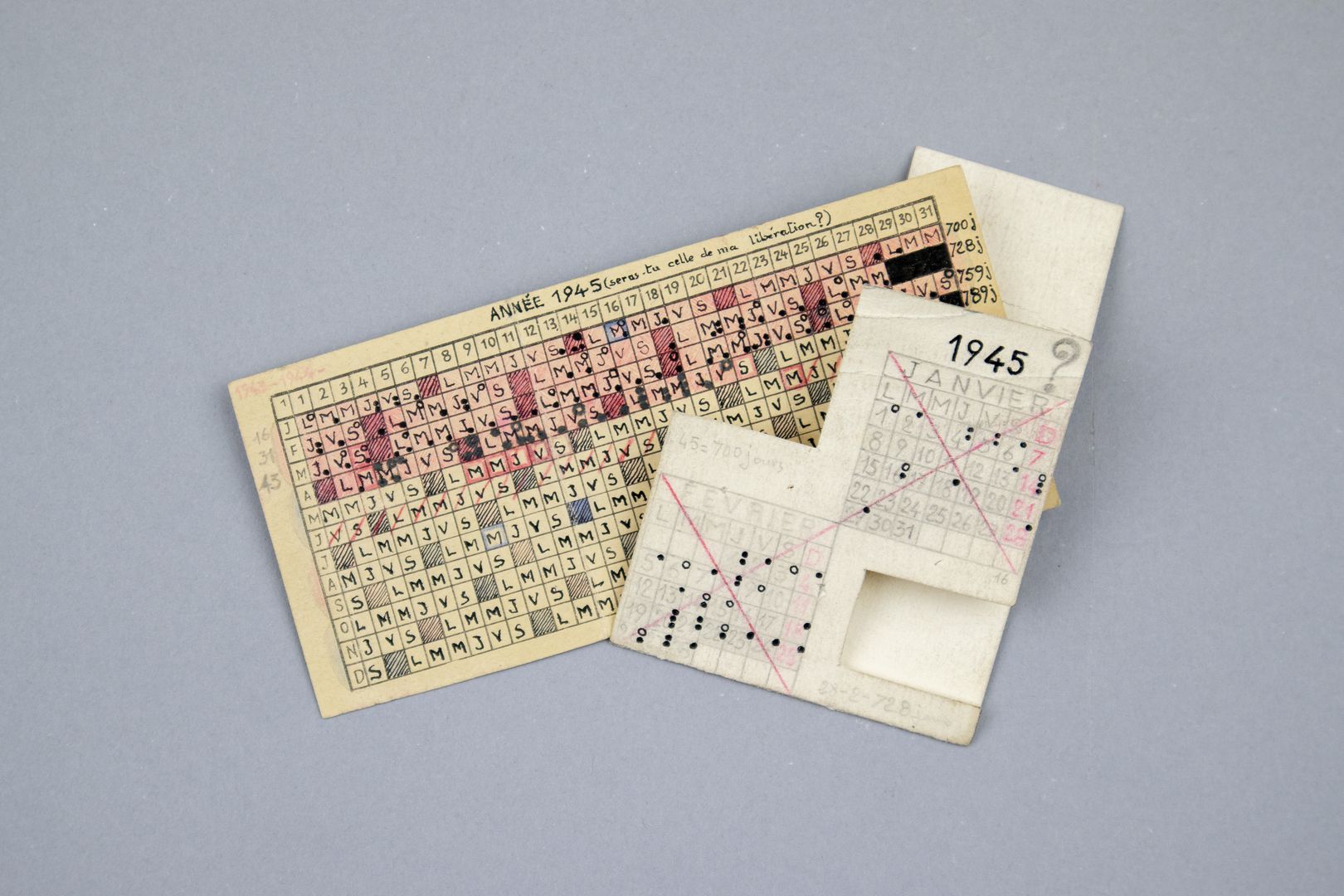

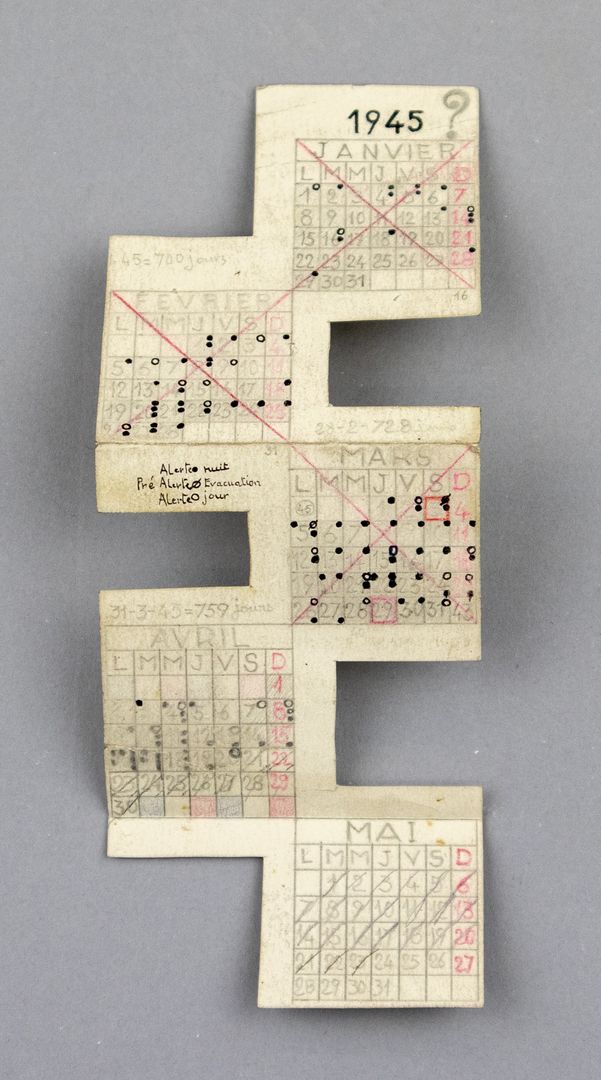
The two hand-made calendars cover the year 1945. In 1993, they were donated to Sachsenhausen memorial. Prior to this, they had been in the possession of Marcel Barré, a former French prisoner.
Life in the concentration camp was devoid of any sense of self-determination. To resist the deprivation of their time, some prisoners secretly kept a calendar, as did the French prisoner Marcel Barré.
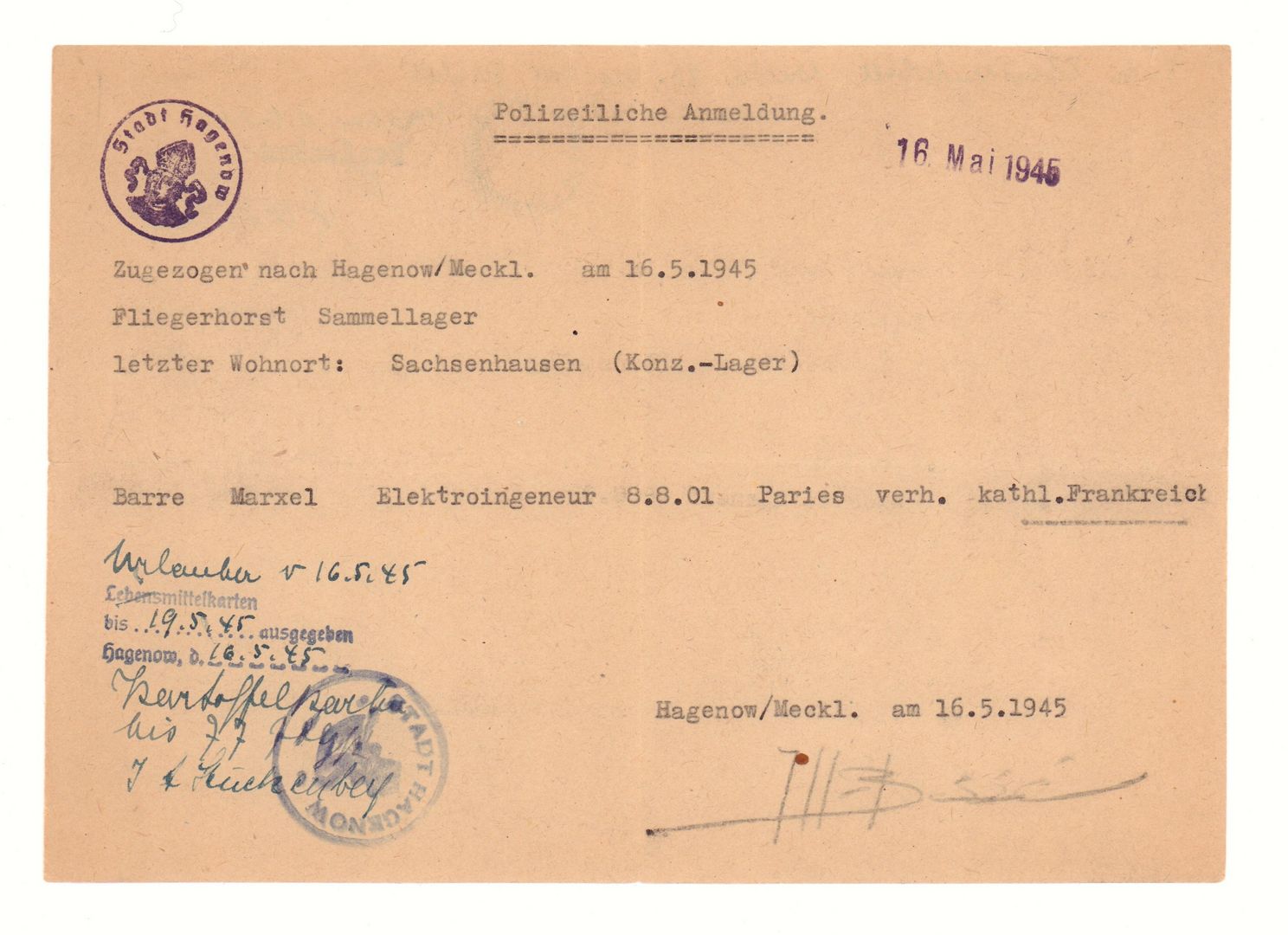
Marcel Barré was born in Paris on 8 August 1901. He was liberated in early May 1945 in Hagenow, near Schwerin. In a new identity document issued there, he had it recorded that he was Catholic and married, and had trained as an electrical engineer. Barré had been imprisoned at Sachsenhausen concentration camp since 10 May 1943. He bore prisoner number 66037 and was forced work at the Heinkel Works. Nothing is known about the circumstances of his imprisonment. His name appears on a list of French prisoners who came from the Eure-et-Loire region, west of Paris.
It is also unclear whether both calendars belonged to Marcel Barré, or just one of them. The owner has added up the days on both calendars, totalling 812 days. According to the calendar, the 812th day was 23 May 1945. On that day, Marcel Barré arrived in Lamballe, a town in Brittany, where he was reunited with his wife. Counting backwards, the count therefore began on 3 March 1943. This could have been the day of Marcel Barré’s arrest, as he was not transferred to Sachsenhausen concentration camp until two months later.
Prisoners secretly made their own calendars to keep track of the days and months in the annual cycle. Some also secretly kept diaries or made notes to make the seemingly endless expanse of time – there was no prospect of release – more manageable by dividing it into clear sections.
Replicas of the calendars were on display in a showcase on the theme of ‘Time and Space’ in the exhibition ‘Daily Life of Prisoners at Sachsenhausen Concentration Camp 1936–1945’, which opened in 2001. After 25 years, parts of the exhibition were dismantled.